

ENS Subgraph
The ENS Subgraph became critical infrastructure
Section titled “The ENS Subgraph became critical infrastructure”Over the years, the ENS Subgraph quietly became one of the most depended-on pieces of infrastructure in ENS. An enormous swath of the ENS ecosystem — and much of the broader web3 / Ethereum ecosystem — reads ENS data through it, directly or indirectly.
Usage at scale
Section titled “Usage at scale”The ENS Subgraph is a cornerstone of the current ENS architecture (ENSv1), handling an extraordinary volume of requests:
- Approx. 2 million average daily requests
- Over 717 million requests annually
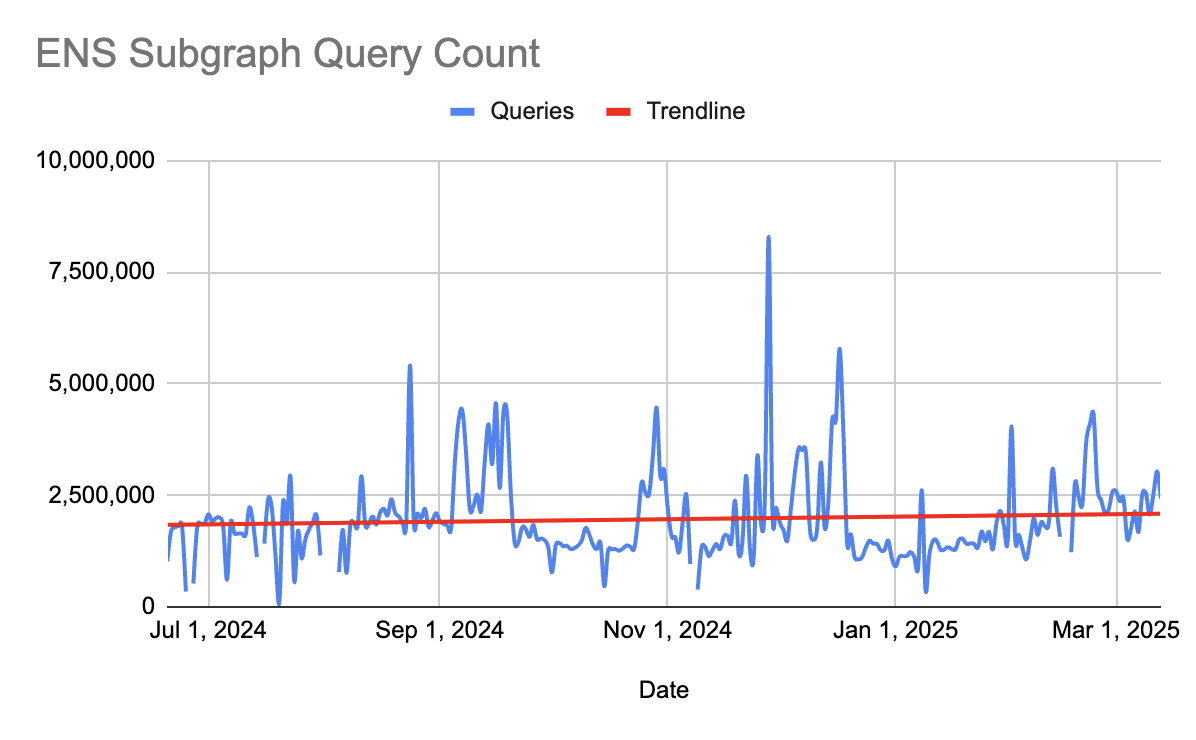
ENS Subgraph daily query volume following the transition to Graph Network hosting (June 20, 2024 onward)
This volume sets the floor: it’s the minimum scale at which any replacement must operate.
Applications dependent on the ENS Subgraph
Section titled “Applications dependent on the ENS Subgraph”The list below is a partial map of the projects and applications that depend on the ENS Subgraph for their functionality — directly, or indirectly through services like the ENS Metadata Service, ENSjs, or the Ethereum Comments Protocol. When ENSv2 launches, indexed ENS data must keep flowing to all of these, or they break.
Critical ENS Apps & Infrastructure
Section titled “Critical ENS Apps & Infrastructure”- Official ENS Manager App — the primary interface for ENS domain management.
- ENS Metadata Service — used by numerous downstream services including NFT marketplaces (OpenSea, Rarible), Rainbow Wallet, and Rotki.
- ENSjs — JavaScript library for ENS integration, used by many ENS-integrated applications.
- ENS Test Environment — testing framework for ENS development.
- Linea Names — primary management interface for
linea.ethsubnames on Linea.
ENS Registrars
Section titled “ENS Registrars”- Grails — by the EthId Foundation.
- ENS Vision
- OpenSea and Rarible — via their dependency on the ENS Metadata Service.
- ENS Tools
- Snipe Zone
- Nameful — by Blockful.
Wallets
Section titled “Wallets”- Rainbow Wallet — mobile wallet and browser extension.
- MyEtherWallet — Ethereum wallet.
- Safe Transaction Service — by Safe.
Chain Explorers
Section titled “Chain Explorers”- Blockscout — blockchain explorer platform.
- EthVM — by MyEtherWallet.
- Cartesi Explorer — by Cartesi.
DAO Infrastructure
Section titled “DAO Infrastructure”- Snapshot.js — TypeScript library for Snapshot integration.
- Snapshot — via Stamp. This is a distinct integration from
snapshot.js. - DAOStar — by Metagov.
- ENS Metadata Manager — by Lighthouse (more info).
- Optimism GovQuests — by Bleu.
ENS History Viewers
Section titled “ENS History Viewers”- ENSvolution — by JustaName.
- PastENS
- Swiss Knife — by apoorv.eth.
- ENS Wayback Machine — by Blossom.
ENS Developer Tools
Section titled “ENS Developer Tools”- ENS Resolver — by Andrew Raffensperger.
- ENS Tools — by ENS Labs.
- ENS Tools — by Serenae.
ENS CLI Tools
Section titled “ENS CLI Tools”- Atlas — by Steve Dylan.
- Ensemble — by estmcmxci.
- Basenames CLI — by estmcmxci.
- Grails CLI — by the EthId Foundation (uses the Grails API, which uses ENSNode).
ENS MCP Servers
Section titled “ENS MCP Servers”- ENS MCP Service — by Namespace.
- ENS MCP Service — by JustaName.
- ENS MCP Service — by Kukapay.
ENS Avatar & Metadata Services
Section titled “ENS Avatar & Metadata Services”- Stamp — by Snapshot Labs.
- ENS Metadata Flarecloud — by the EthId Foundation.
ENS Contract Naming Platforms
Section titled “ENS Contract Naming Platforms”Ethereum Libraries
Section titled “Ethereum Libraries”- safe-eth-py — by Safe.
ENS Social Media Services
Section titled “ENS Social Media Services”- ENS Market Bot — by the EthId Foundation.
AI Agents / x402 / Micropayments / Proof of Humanity
Section titled “AI Agents / x402 / Micropayments / Proof of Humanity”DeFi Applications
Section titled “DeFi Applications”- Rotki — privacy-preserving portfolio tracking.
Social Applications
Section titled “Social Applications”- Ethereum Follow Protocol — onchain social graph protocol.
- LinkChain (GitHub)
- Dapp Rank — by Joel Thorstensson.
- Decentraland Builder (GitHub) — by Decentraland.
- Decentraland Creator Hub (GitHub) — by Decentraland.
Other Key Applications
Section titled “Other Key Applications”- ENSPro — by NameStone.
- ENSBook — by Liuliuben.
- L2 Subnames — by Namespace.
- ENS Data — by Pugson.
- ENS Ideas — by Frolic.
- Next.ID — which also powers Web3.bio (by Yan Zhu) and Eth.cd (by Webhash / Hid).
What this means
Section titled “What this means”The breadth of applications above shows that indexed ENS data is critical infrastructure for ENS and the broader ecosystem — and that there is large, proven demand for it today. When ENSv2 launches, the Subgraph’s Key Limitations become breaking for these apps. ENSNode exists to keep indexed ENS data flowing through the transition and beyond, with a robust, scalable, multichain, ENSv2-ready replacement.
Already building directly on ENSNode
Section titled “Already building directly on ENSNode”A growing set of companies and apps have already moved onto ENSNode and future-proofed their ENS applications — see who’s already building on ENSNode.
Next Steps
Section titled “Next Steps”Next, consider the key limitations of the legacy ENS Subgraph.
Or, prepare your app or platform for ENSv2 by adopting ENSNode’s Omnigraph API.